
Gold filled is a type of jewelry material that is made by bonding a layer of solid gold to a base...
Most jewelry makers know what gold filled jewelry is. Far fewer know how it's actually made.
At JK Findings, we've been manufacturing gold filled jewelry findings in Rochester, New York for more than 25 years. As one of the leading jewelry manufacturers serving designers and businesses across the country, we've seen firsthand how much confusion still exists about the gold filled manufacturing process.
Understanding how gold filled material is produced can help jewelry makers better explain its value to customers and make informed sourcing decisions when purchasing wholesale jewelry supplies.
What Is Gold Filled Material?
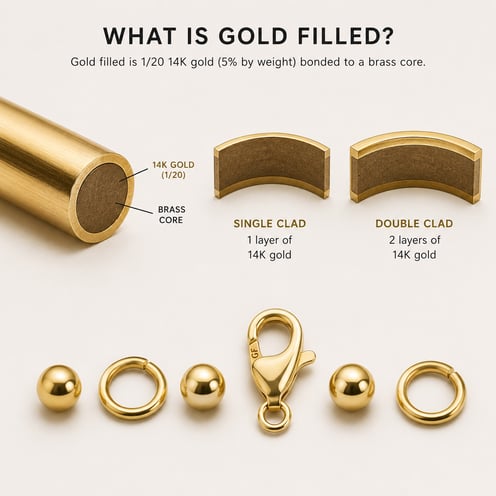
Gold filled material is created by permanently bonding a thick layer of karat gold to a base metal core, typically brass. By legal standard in the United States, gold filled products must contain 1/20th, or 5%, gold by total weight.
Unlike gold plating, where a thin layer of gold is deposited onto a surface, gold filled material contains a substantially thicker layer of gold that becomes an integral part of the metal itself.
The result is a durable material that offers the appearance and wearability of solid gold at a more accessible price point.
Step 1: Creating the Gold Filled Bond
The process begins with sheets of karat gold and brass.
Depending on the intended application, manufacturers may use:
- Double clad material, where gold is bonded to both sides of the brass core
- Single clad material, where gold is bonded to only one side
These metal layers are carefully assembled and placed into a controlled manufacturing environment.
Using extreme heat and thousands of pounds of pressure, the metals are fused together at a microscopic level. This creates a permanent metallurgical bond between the gold and brass.
Because the gold becomes physically bonded to the base metal, it will not peel, flake, or separate like plated finishes can over time.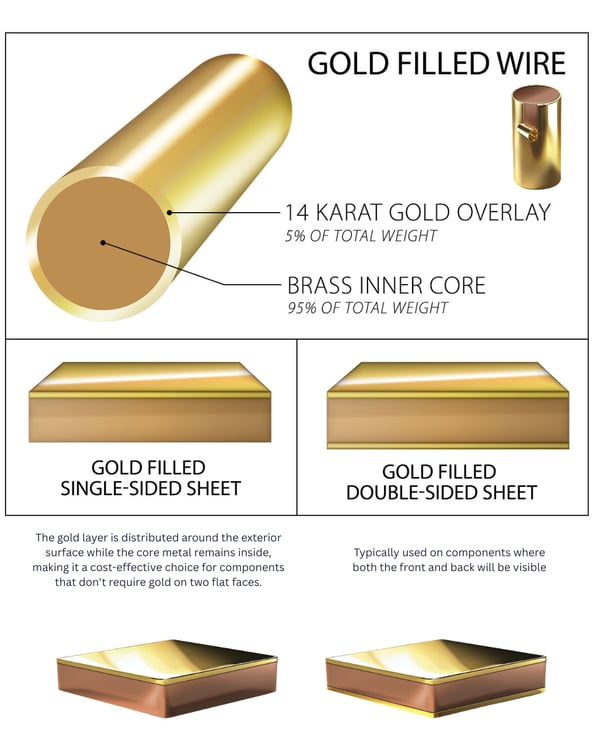
Step 2: Rolling the Material to Precise Specifications
Once bonded, the material undergoes a series of rolling operations.
The metal passes through industrial rolling mills repeatedly, gradually reducing its thickness while maintaining the required gold-to-base-metal ratio. Throughout this process, the material continues to meet the legal gold filled standard of 1/20th gold by weight.
Precision is critical at this stage. The final dimensions must meet exact specifications while preserving the integrity of the bonded gold layer.
Step 3: Transforming Raw Material into Jewelry Components
After rolling, the gold filled material can be formed into a variety of products, including:
- Sheet
- Wire
- Tube
- Chain
- Jewelry findings
These materials are then manufactured into the components jewelry designers use every day, including jump rings, clasps, ear wires, connectors, head pins, and other wholesale jewelry findings.
As wholesale gold filled jewelry manufacturers in the USA, we use these materials to produce both jewelry components and finished jewelry pieces that are designed for long-term wear.
Why Gold Filled Jewelry Cannot Be Cast 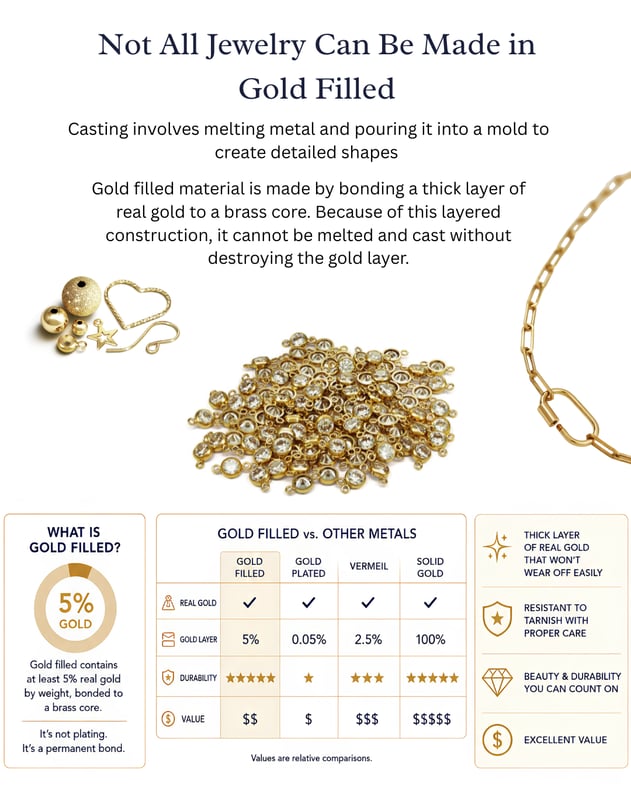
One of the most common misconceptions about gold filled jewelry is that it can be cast like other jewelry metals.
In reality, gold filled material cannot be cast.
Casting requires metal to be melted and poured into a mold. If gold filled material were melted, the bonded gold layer would be destroyed, eliminating the very characteristic that makes it gold filled.
This is why gold filled is most commonly used for products made from wire, sheet, tube, and chain, such as:
- Clasps
- Jump rings
- Ear wires
- Chain
- Wire-formed components
More intricate charms, sculptural designs, and detailed cast pieces typically need to be produced using other manufacturing methods and materials.
Engineering, Metallurgy, and Craftsmanship
Gold filled manufacturing is much more than simply combining two metals.
The process requires careful engineering, precise metallurgical control, and skilled craftsmanship to create materials that can withstand years of everyday wear while maintaining their beauty.
For jewelry designers, understanding this process helps explain why gold filled continues to be one of the most trusted materials in the industry.
Partner with a Trusted U.S. Jewelry Manufacturer
For more than 25 years, JK Findings has supplied designers, retailers, and manufacturers with high-quality wholesale jewelry supplies and wholesale jewelry findings made in Rochester, New York.
From chains and clasps to finished jewelry and custom manufacturing capabilities, we are proud to be among the leading wholesale gold filled jewelry manufacturers in the USA. Explore our complete selection of gold filled findings and finished jewelry to discover components designed for quality, consistency, and lasting wear.